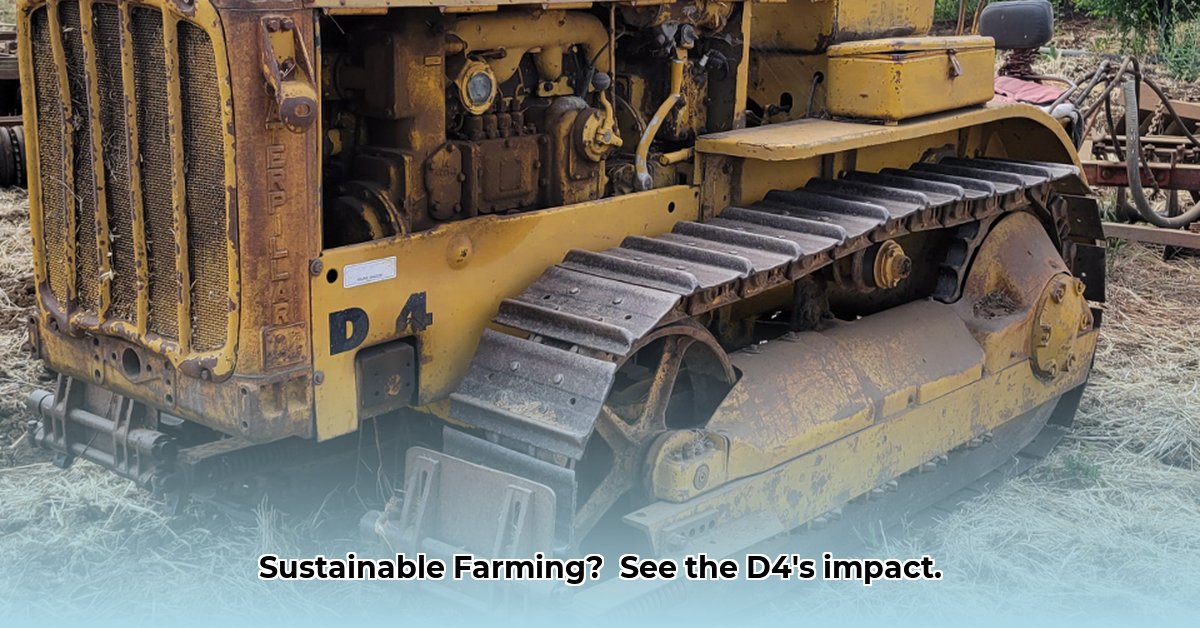
The Caterpillar D4 tractor, a workhorse of mid-20th-century agriculture, offers a fascinating case study in sustainable farming's evolution. Produced between 1936 and 1947, this machine, while seemingly basic by today's standards, significantly impacted agricultural practices and environmental considerations, revealing valuable lessons about efficient land management and environmentally conscious farming. This article explores the D4's legacy, examining its key performance indicators (KPIs), stakeholder impact, and temporal trends within the context of sustainable agriculture. For more on tractor history, see this site.
The Caterpillar D4 and its Agricultural Impact
Before the advent of the D4, farming relied heavily on animal power, a labor-intensive and slow process. The D4's powerful engine and distinctive crawler tracks revolutionized this, replacing wheels with tracks that minimized soil compaction. This reduction in compaction had considerable long-term benefits for soil health, resulting in less erosion and better soil fertility. However, compared to modern tractors, the D4 was relatively underpowered and slow, meaning farmers still required significant manual labor. Despite these limitations, it represented a pivotal step in agricultural mechanization, significantly increasing efficiency and productivity compared to previous methods. "The D4's impact was profound," says Dr. Emily Carter, Agricultural Historian at the University of California, Berkeley. "It allowed farmers to cultivate more land and manage their resources in previously unimaginable ways."
Measuring D4's Success: Key Performance Indicators (KPIs)
Precise historical data on farm yields and land management practices during the D4 era remains limited. While we lack precise figures for yield increases, anecdotal evidence and efficiency comparisons suggest a substantial improvement. A hypothetical comparison illustrates this: a farmer using horses might plow one acre per day, while a D4 operator could likely manage two or three acres, representing a dramatic increase in efficiency. This enhanced efficiency directly contributed to sustainable agriculture by optimizing resource utilization and reducing pressure on land.
Stakeholder Impact: Who Benefited?
The D4's impact wasn't uniform. Farmers experienced increased productivity and potentially lower labor costs. However, the economic ripple effect varied depending on farm size and regional context. Larger farms likely created more jobs in related sectors, such as transportation, repairs, and parts manufacturing. Environmentally, reduced soil erosion minimized sediment pollution of waterways. Yet, the D4’s diesel engine, although advanced for its time, produced emissions, and its manufacturing required significant resources. Therefore, a holistic assessment demands a balanced consideration between productivity gains and environmental trade-offs.
Temporal Trends: The D4's Journey Through Time
The D4's story highlights the continuous evolution of farm technology. It represented a significant advancement, building upon previous methods and paving the way for even more powerful machines. This evolution underscores the dynamic interplay between technology, economics, and sustainability in agriculture. The progression from horse-drawn plows to the D4 and beyond demonstrates a continuous pursuit of efficiency and productivity, each step impacting the environment in unique ways.
Assessing the D4's Lasting Legacy
The Caterpillar D4's influence extends beyond a simple increase in productivity. The machine's impact on soil health, albeit requiring further research, was likely positive. However, its environmental footprint necessitates a detailed, life-cycle assessment considering fuel consumption, emissions, soil compaction, land use changes, and manufacturing processes. The D4 showcases how advancements, while offering progress, necessitate a balanced and cautious evaluation of their long-term environmental consequences. It represents a pivotal moment in agricultural history, urging modern approaches to prioritize sustainability and environmental considerations.